


Wet pants
Children and daytime incontinence
For children, it is very important to stay dry and to have control over their bowels and bladder.
Incontinence and stool leakage can lead to feelings of shame or even bullying among friends.
Fortunately, most children have learned to control their bladder before they are 4 years old and start kindergarten. Children who wet themselves even though they should already be dry and clean have a frustrating problem that is often considered taboo and embarrassing. Neither the child nor the parents feel proud of it. A child does not want to stand out from others for any reason — and certainly not because of wet underwear. Is the child simply lazy, or could psychological problems, physical causes, or something else entirely be behind the issue? In any case, an uncontrollable bladder can reduce your child’s quality of life.
The first step is to clarify the cause of the problem. After that, the child needs support in following the advice and guidelines from medical science regarding incontinence. In all cases, it is important to consult your doctor so that it can be examined how the child can best be helped.
At Urifoon, we specialize in both daytime and nighttime incontinence. If your child wets the bed, you can find help on our bedwetting pages. We recommend treating daytime incontinence first.
How many children have problems with incontinence?
About 10% of all kindergarten children still wet themselves during the day, which means around 2 children per class. Fortunately, most children outgrow the problem, and as a parent there is a lot you can do to support and speed up this development, so that the problem also feels smaller for the child. First and foremost, however, it is important to identify the causes of the incontinence.
The reason why children urinate in their pants during the day.
In the past, it was often assumed that psychological problems were the cause. However, this is only rarely the case. Daytime incontinence in children often has the following causes:
-
The child suffers from constipation.
-
The child has an overactive bladder.
-
The child waits too long and “forgets” to go to the toilet because they are so busy playing.
-
The child has a urinary tract infection.
Some children suffer from what is known as “giggle incontinence,” where they literally wet themselves from laughing. These children can often improve the problem through pelvic floor training.
Going to the toilet too often...
Some children urinate very often and need to go to the toilet almost every hour. They constantly feel that they need to go. Not because they like it so much, but because their bladder is sending a signal that they need to use the toilet. Because they go so often, the amount of urine is small, and the bladder can also become smaller over time. The more urine the bladder holds, the larger it becomes. Sometimes these children lose urine without noticing it.
Or not going to the toilet often enough...
Other children do not go to the toilet often enough. They hold their urine for too long because, for example, they do not feel like going to the toilet. When they hold their urine, the feeling may disappear for a moment, but their bladder is still full. Their bladder can also become too large and overstretched, which is not good either. It may even overflow, leading to wet trousers.
How often should a child go to the toilet?
-
Going to the toilet 1 to 4 times a day is too little.
-
Going to the toilet 5 to 8 times a day is good.
-
Going to the toilet 8 times or more is too much.
Going to the toilet 6 times a day would be ideal:
-
Once when waking up in the morning
-
Once during the break at school
-
Once at lunchtime
-
Once after school in the afternoon
-
Once around dinnertime
-
Once before going to sleep
How much should a child drink?
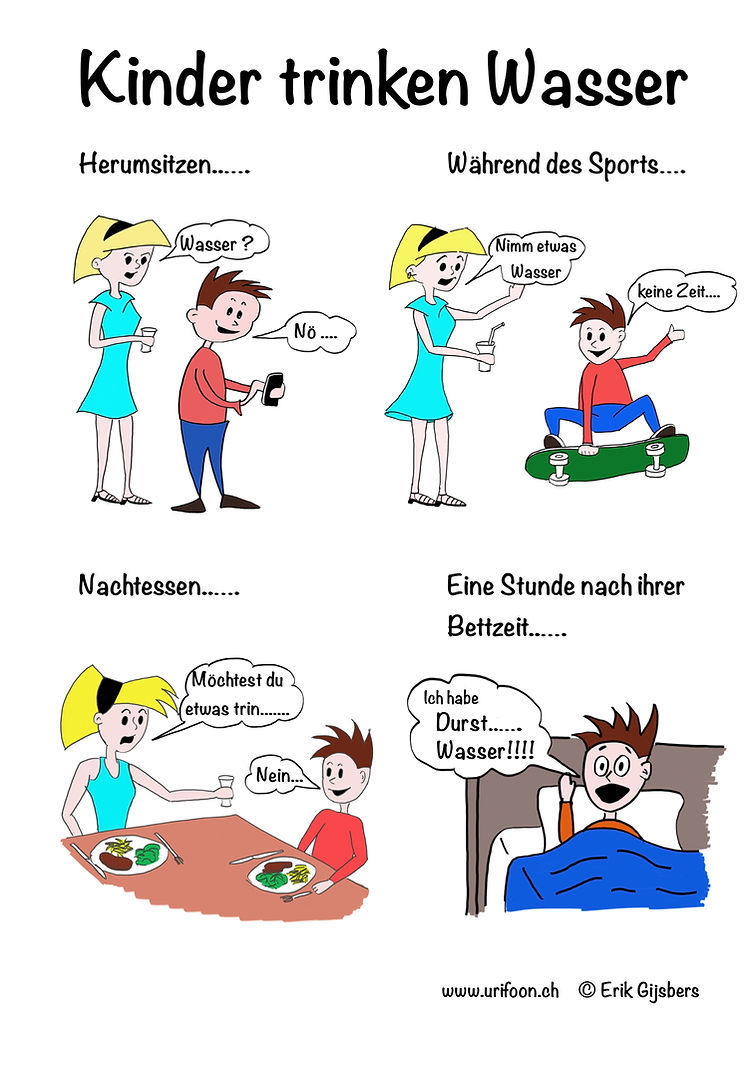
To be able to go to the toilet properly, a child needs to drink enough. Primary school children do best with 1.2 to 1.5 liters per day. That is about 6 to 8 glasses a day, spread throughout the day.
Bowel movements
Wet trousers can also happen when a child holds back bowel movements for too long.
Some children have stool or fecal stains in their underwear. This happens automatically, without them feeling the urge to go to the toilet. It occurs when a child does not go to the toilet often enough or does not empty all the stool. The bowel becomes blocked, the stool becomes hard, and it is difficult to pass. New, softer stool then slips down past the old hard stool and ends up in the underwear without the child noticing.
-
Fewer than 3 bowel movements per week is too little.
-
The stool should ideally be shaped like a sausage, either curved or straight.
-
Hard stool is not good.
-
Stool in the underwear is not good either.
Help and support
We offer practical “toilet watches” to help your child remember to go to the toilet regularly during the day. The watches vibrate discreetly and look cool.
To help avoid wet trousers, we also have comfortable absorbent underwear. This gives the child confidence and helps them feel less embarrassed.
If your child has ongoing problems, visit a pediatric physiotherapist who specializes in pelvic floor training, or attend a urology clinic at one of the children’s hospitals near you.
Drinking and peeing...
Drinking during the day is important for healthy toilet habits in children.
Many children struggle with wet trousers or stool stains in their underwear during the day. Some children also wet the bed at night.
Urine loss and stool loss can lead to shame or bullying. Because children are unable to control their bladder and bowels properly, they often act as if the problem does not exist. For many children, this can feel like one of the worst things that can happen to them.
Children often do not take enough time to empty their bladder properly. If they sit in the wrong position on the toilet or hold their urine for too long, this can lead to urine loss or bladder problems.
Sometimes children ignore the urge to have a bowel movement because they do not feel like going to the toilet or because they do not want to sit on a different toilet. This can lead to constipation, which means they cannot empty properly and this increases the risk of urine leakage.

Vibralite wristwatch

Daytime alarm

Absorbent underwear
Customer service
about us
Terms and Conditions
Return slip
Shipping – Delivery
Privacy Policy
Questions and Answers
Legal Notice (Imprint)
Information
Size chart
Pjama size chart
Links
Pinboard
Videos
Instructions for use
Washing instructions
Incontinence
Children during the day
Adults during the day
Bedwetting
Downloads
Online Rental Agreement
Rental Agreement by Post (DE)
Score Card
Doctor's Prescriptions
Brochure
Bedwetting alarm Liberty
Bedwetting alarm Pjama
Children’s underwear
Adults’ underwear
Vibra reminder watch
Pjama pants